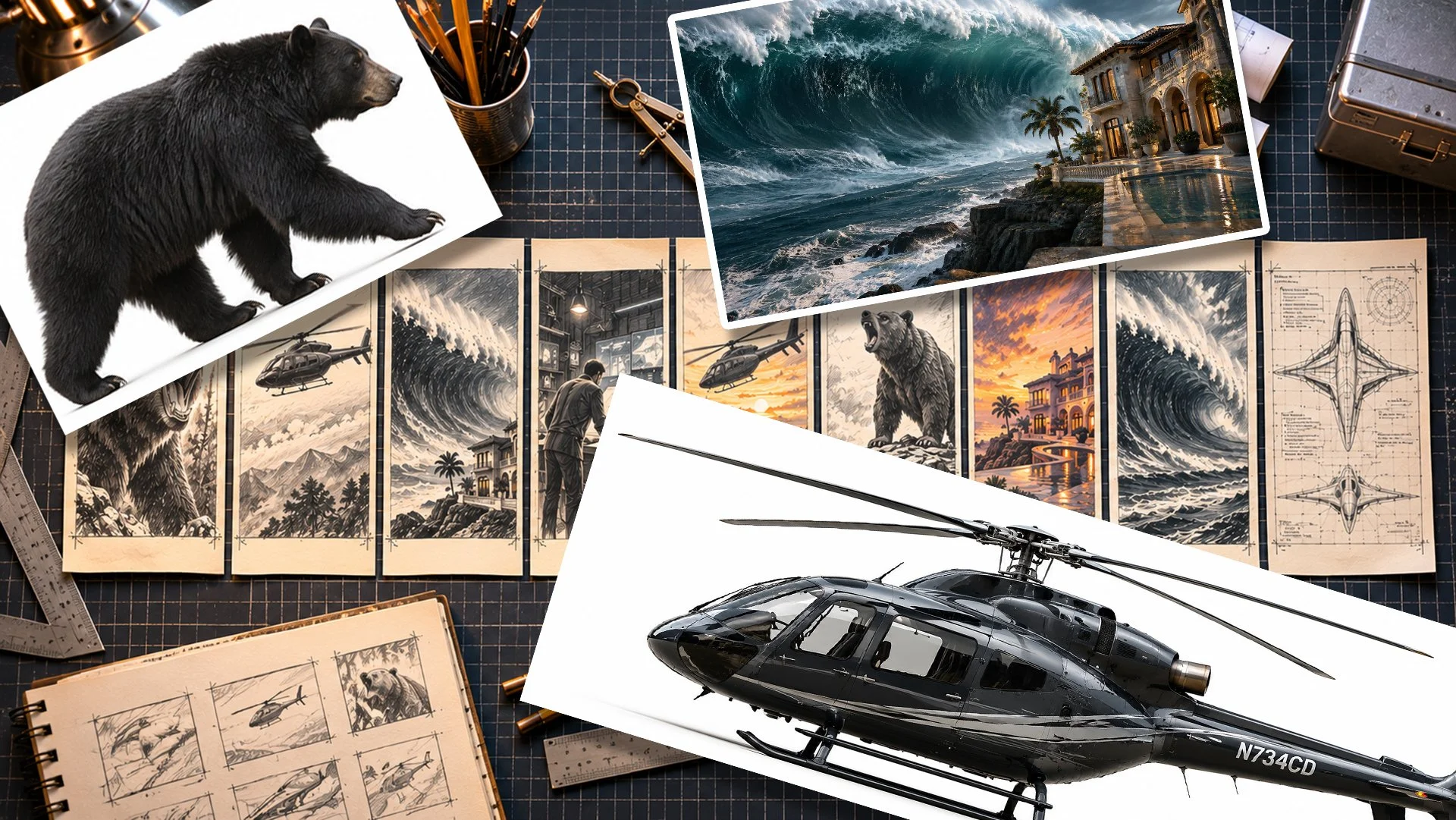
On a recent online prep call for our upcoming TVOT panel, we talked about AI, Hollywood talent, and a bear trying to board a helicopter before a tidal wave hit. Naturally, we ended up talking about money.
I will be moderating “Vertical Is the New Prime Time: How AI and Microdramas Are Rewriting Television” on December 2 at TVOT, 1:10–2:00 PM, in the Sarnoff Room. I’ll be joined by Erwin More, Sophia Xing, Q Zhang, Tony Mugavero and Jesse Z. The question I brought into the recent Zoom call was simple, “When a microdrama becomes a hit, who gets paid?”
The pitch and the paperwork
Erwin More brought us down to earth. “What originally gets presented to me in terms of what the deal is going to look like shifts very quickly when I move away from the creative buyers to the lawyers who are trying to make those deals.”
So if you want established writers, directors, or actors to work at microdrama budgets, you have to give them a reason to say yes.
Jesse Z. has seen some platforms move away from minimum guarantees and toward revenue sharing. That can leave creators paying to make the show upfront, then waiting for a cut of revenue they may have little ability to verify. AI can bring down the cost of making a show. It can’t tell you what the platform owes you.
If I’m footing the bill, I want to know how my share gets calculated, what I get to see in the reporting, and who owns the series if there’s a second season. The day to ask those questions is before the first shoot.
How many times can you watch the bear?
I kept coming back to that bear. A bear. A helicopter. A tidal wave. I’d probably stop scrolling, too. The harder question is whether I’d come back tomorrow to see what happens to the bear.
Sophia Xing asked what we actually mean by a successful microdrama. Are we counting views, turning a profit, or building a property with a life beyond its first run? Those are three different report cards.
Jesse made the point that as more teams get access to the same AI tools, the story and the underlying IP start to matter more. I buy that. If anybody can make the tidal wave, I want to know what you can make me care about.
Give the phone a few more genres
Q Zhang raised a possibility I like. An AI-made series can be a finished work and a proof of concept for a bigger-budget adaptation. A creator can put an actual story in front of an audience and see which characters they want to follow. That’s a different pitch from asking someone to imagine the show from a deck.
Romance and revenge came up, of course. So did science fiction, fantasy, thrillers, horror, and young adult stories. We had different bets on what would work vertically. Good. I’d like to see what a horror filmmaker does with the intimacy of a phone screen. You’re holding the thing that’s about to scare you.
Storytellers are rising up all over the world with or without Hollywood. I’m interested in what they do when they can test an idea with an audience and still own enough of it to decide what comes next.
Who else will pay to make the show?
Advertisers helped finance television long before anyone watched it with their thumb. So what happens when a brand commissions a vertical series outright?
Q pointed to book authors commissioning adaptations from creators in the Leyline cohort. Sophia talked about using AI to add product placement to live-action shows after filming. Erwin sees a fit between brands and specific vertical audiences, though he’s seen few big deals firsthand.
I keep coming back to the commissioned series. If a brand can fund a show its audience would choose to watch, the creator has another way to finance the work. The test is whether anybody wants episode two.
That’s where I want to pick up the conversation on December 2 in San Francisco. This was a great kickoff to that conversation. We’ll talk about what AI lets us make, what viewers will come back for, and what a creator gets to keep when the show takes off.
About the Speakers
Erwin More, Founding Partner/More Medavoy Management
Sophia Xing, founder of Plot Party
Qiushi (Q) Zhang, Founder & CEO, LeyLine
Jesse Z., founder of Storyverse AI
Tony Mugavero, CEO RAD TV
Curt Doty, founder of CLOWD FILM FEST and CLOWD TV.
About the Author
Curt Doty is a former studio executive and award-winning creative director with deep leadership experience across the entertainment and branding industries. Ten years in Television. Ten Years in Movies.
As the founder of CurtDoty.co, a creative consultancy, Curt has led integrated marketing, multi-channel storytelling, branding, identity, and user experience initiatives for a diverse roster of clients.
Over the past 15 years, Curt has leaned into innovation—leading R&D projects at Apple, Toshiba, and Microsoft, and pioneering interactive content and vertical storytelling.
Today, Curt’s work also explores the intersection of AI and entertainment. A sought-after fractional leader (CCO, CMO), speaker, and AI educator, he focuses on demystifying AI for creatives and executives alike.
Curt just completed the first CLOWD AI Film Festival. Check it out here and learn who won.
Curt is a sought-after public speaker having been featured at Mobile Growth Association, Mobile World Congress, App Growth Summit, Promax, CES, CTIA, NAB, NATPE, MMA Global, New Mexico Angels, PRSA, EntrepeneursRx, Digital Hollywood, SHRM, Streaming Media NYC, and Davos Worldwide. Download his speaker press kit here.
Through public speaking, keynotes and podcasts, Curt is continuing his role as a visionary voice in the future of creativity. He is a board member of The Human AI Innovation Commons, Encoding Equity Into AI-Generated Prosperity. A framework for ensuring the innovations arising from Human – AI collaborations benefit humanity broadly, not just corporate shareholders. Curt is also a board member of the Godfrey Reggio Foundation.