The AI Film Backlash Misses the Real Revolution
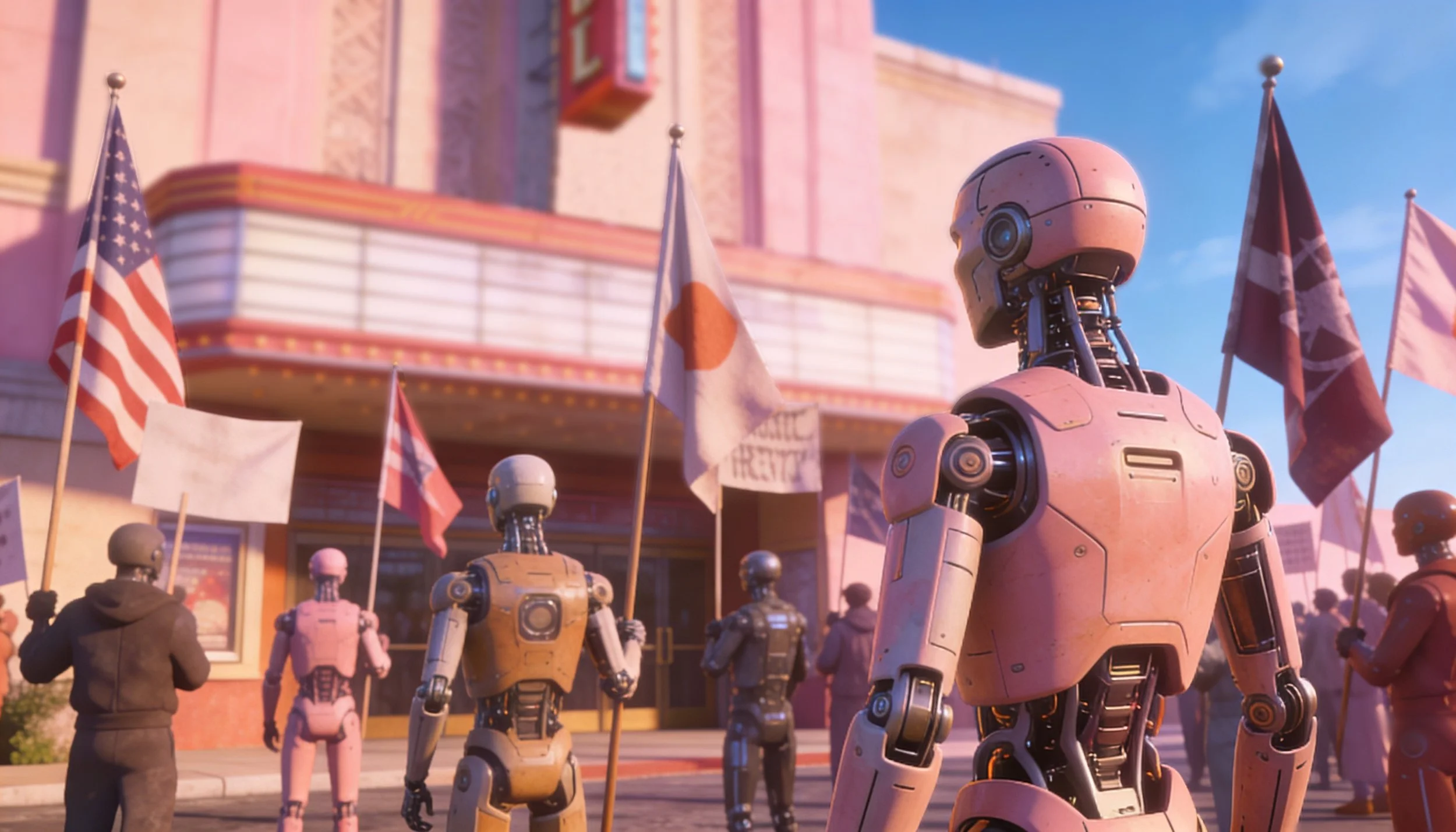
Seedream 4.5: Curt Doty
I’ve written—and spoken—a lot about AI and film since generative AI broke containment and entered the cultural bloodstream. And yes, let’s get this out of the way early: film represents roughly 1–2% of the total global AI market. This is not where the real money is. This is not where Big Tech makes its quarterly nut.
But it is where meaning gets negotiated.
For those of us who’ve spent decades inside film and television, this moment hits differently. I’ve lived through the transition from celluloid to digital, from practical effects to VFX, from optical compositing to motion capture, from tape decks to timelines. Every one of those shifts arrived with panic attached. Every one of them was framed as an existential threat. And every one of them ultimately became… a tool.
The craft evolves. The tools evolve. Storytelling persists.
That’s the throughline people keep missing.
Today, AI is already embedded across the industry—quietly, unevenly, and often without fanfare. From independents to global studios. From pre-viz to post. From cleanup to color. And yes, from directors you wouldn’t dare call unserious: Darren Aronofsky, James Cameron, George Miller.
Aronofsky’s decision to experiment openly with AI—starting with a documentary, not a cyberpunk dystopia—wasn’t naïve. It was courageous. And predictably, he was met with disproportionate hostility from the loudest corners of the AI-hater industrial complex. That backlash says more about fear than about film.
George Miller, while leading the jury at the OMNI Film Festival, put it more plainly in The Guardian:
“It will make screen storytelling available to anyone who has a calling to it.”
That’s not a tech claim. That’s a cultural one.
And it leads us to the point most discussions avoid:
This is not about content. This is not about engagement. This is not about technology.
This is about storytelling.
Four Paths Forward (Not One Apocalypse)
The future of AI in film isn’t a single outcome. It’s already diverging into four distinct paths:
Hybrid features
Animated features
Fully AI-generated features
Advertising
Hybrid films are already here. AI is now foundational—used somewhere in the workflow by studios large and small. This isn’t theoretical. It’s operational. And it’s improving daily.
Where AI truly finds its footing, however, is animation.
Stylization matters. Pixar-adjacent worlds, anime aesthetics, graphic abstraction—these forms don’t pretend to be human. They don’t trigger the same uncanny alarms. For experienced animators, AI is radically compressing production timelines, collapsing bloated pipelines, and freeing artists to focus on what actually matters: performance, tone, rhythm, story.
When used by artists, AI empowers artistry. When used by opportunists, it produces slop.
That distinction is everything.
If AI were truly “replacing filmmakers,” we’d already be drowning in hundreds of feature films. We’re not. Despite a few theatrical releases, the promise of speed has not yet translated into volume—or quality. Why? Because audiences don’t judge AI films. They judge films.
Look at the reaction to Aronofsky’s On This Day… 1776. The hostility wasn’t technical. It was instinctual. We are pattern-recognizing creatures. Even when we can’t articulate why something feels off, we know it.
AI still feels like AI.
And no amount of resolution, frame interpolation, or stylistic mimicry fully resolves that—yet.
Advertising, on the other hand, is a natural fit. Short-form. High velocity. Surreal. Disposable. The recent Super Bowl spots proved the point. AI studios are popping up everywhere—not to make movies, but to explore visual language at speed.
That’s not cinema. And that’s okay.
Get It Off YouTube. Put It on the Big Screen.
Which brings me to the real question: How do we help audiences process this new art form?
You don’t do it alone on a phone.
You do it together, in a theater.
That’s the mission of the CLOWD AI Film Festival. No online premieres. No algorithmic isolation. We insist on in-person screenings, on the big screen, with real audiences.
Why? Because cinema has always been a social act.
We want filmmakers, technologists, artists, and audiences in the same room—watching the same images, then talking about what they just saw. Not debating prompts. Not litigating tools. But asking deeper questions: What felt authentic? What didn’t? Where was the human hand visible? Where was it missing?
As Renard T. Jenkins—President & CEO of I2A2—has said:
“Every technology shift promises efficiency. But quality storytelling has always remained a human endeavor.”
That’s not nostalgia. That’s history.
At CLOWD, questions of value, authorship, craft, and humanity aren’t side panels—they’re the core programming. The screenings matter, but the conversations afterward matter just as much.
Because this shift is not slowing down.
Champions of the Edge
We are unapologetic champions of cinema, motion design, visual effects, and emerging artistic voices—especially international creators working at the edge of new tools. Generative AI is changing the relationship between image and truth, between authorship and output, between intention and execution.
Ignoring that won’t preserve cinema. Engaging with it responsibly might.
Renard Jenkins frames it best:
“AI in the hands of great storytellers won’t erase authorship—it will expose it.”
That’s the bet.
The wave is already here. The only real choice left is whether filmmakers ride it with intention—or get dragged behind it by fear.
Story is still the point. Everything else is just a tool.
About the Author
Curt Doty is a former studio executive and award-winning creative director with deep leadership experience across the entertainment and branding industries. Ten years in Television. Ten Years in Movies.
As the founder of CurtDoty.co, a creative consultancy, Curt has led integrated marketing, multi-channel storytelling, branding, identity, and user experience initiatives for a diverse roster of clients.
Over the past 15 years, Curt has leaned into innovation—leading R&D projects at Apple, Toshiba, and Microsoft, and pioneering interactive content.
Today, Curt’s work also explores the intersection of AI and entertainment. A sought-after fractional leader (CCO, CMO), speaker, and AI educator, he focuses on demystifying AI for creatives and executives alike.
Curt is a sought after public speaker having been featured at Mobile Growth Association, Mobile World Congress, App Growth Summit, Promax, CES, CTIA, NAB, NATPE, MMA Global, New Mexico Angels, PRSA, EntrepeneursRx, Digital Hollywood, SHRM, Streaming Media NYC, and Davos Worldwide. Download his speaker presskit here.
Through public speaking, keynotes and podcasts, Curt is continuing his role as a visionary voice in the future of creativity. He is now a board member of The Human AI Innovation Commons, Encoding Equity Into AI-Generated Prosperity. A framework for ensuring the innovations arising from Human – AI collaborations benefit humanity broadly, not just corporate shareholders.