
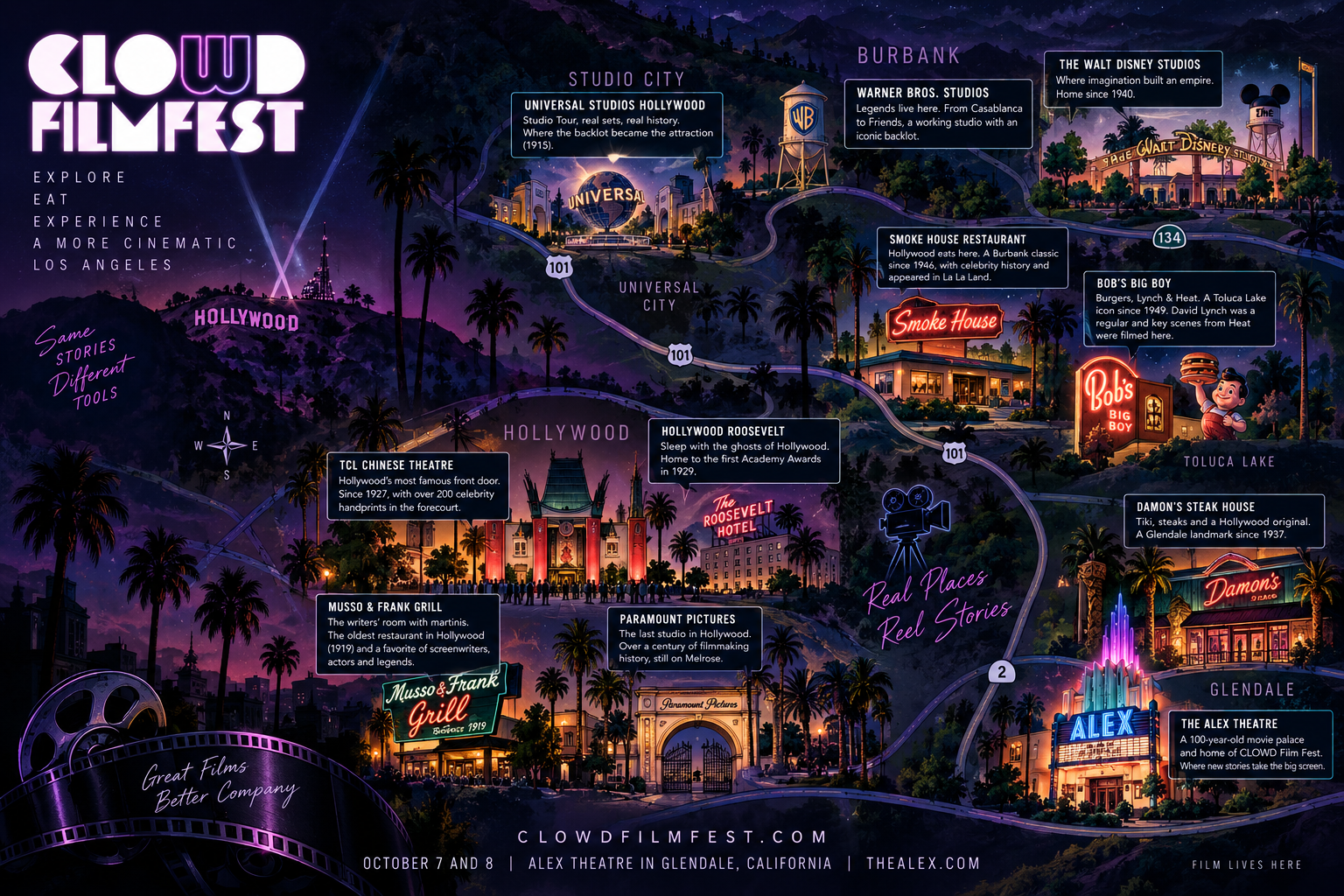
While you are here…
100 Years of Hollywood in 11 Stops.
We put together a little guide for you so you know the history, trivia and locations in the area that might mean something to a true film buff
BURBANK & TOLUCA LAKE
Smoke House Restaurant
Eat Where Hollywood Eats!
Opened in 1946 and sitting practically against the Warner Bros. lot, the Smoke House is old Hollywood without the velvet rope. Bob Hope and Bing Crosby were early regulars, and in the ’60s you could apparently find the dining room full of costumed Western extras grabbing lunch between takes. More recently, it appeared in La La Land. Come for the Hollywood ghosts; stay for the famous garlic cheese bread.
Bob's Big Boy
Burgers, Lynch & Heat
Built in 1949, this Streamline Moderne landmark is the oldest surviving Bob’s Big Boy in America—and a little piece of Los Angeles cinema frozen in neon. Michael Mann filmed key scenes from Heat here, including the diner where Robert De Niro recruits Dennis Haysbert’s character for the final score. David Lynch was also a longtime regular, while the Beatles ate here during their 1965 U.S. tour. Order a burger, find the Beatles booth, and contemplate whether your next meeting should involve a heist.
The Walt Disney Studios
Where the Mouse Built an Empire
Disney moved into its Burbank studio in 1940, creating a 44-acre filmmaking campus for animation, live action, sound, editing, music and everything between. One wonderfully analog relic remains: the signpost at Mickey Avenue and Dopey Drive, installed for The Reluctant Dragon in 1941 and never removed. The studio is still a working facility rather than a normal tourist attraction, so access is limited—but even driving past puts you beside nearly nine decades of entertainment history.
Warner Bros. Studios
The Backlot Next Door
If the Smoke House is where Hollywood had lunch, this is where it went back to work. The 110-acre Warner Bros. lot has hosted everything from A Star Is Born and Blade Runner to Friends and The Big Bang Theory, and its backlot streets have impersonated countless places that are nowhere near Burbank.
GLENDALE
Damon's Steak House
Glendale Goes Tiki
Damon’s has been pouring a little South Pacific into Glendale since 1937. Founder Loyal Damon started the restaurant on Central Avenue; the tropical fantasy eventually grew into the wonderfully unapologetic tiki interior now on Brand Boulevard. Think prime rib, Mai Tais, bamboo booths, tropical murals and an outrigger hanging overhead. Before themed restaurants became a corporate concept, Damon’s understood something Hollywood has always known: sometimes the room is part of the show.
The Alex Theatre
Where CLOWD Meets a Century of Cinema
And, of course, there’s our own movie palace. The Alex gives CLOWD filmmakers something a laptop never can: scale, darkness, strangers sitting together and that slightly terrifying moment when the lights go down. For AI filmmakers, it’s more than a venue—it’s the test. Does the story survive the big screen?
HOLLYWOOD
TCL Chinese Theatre
Hollywood's Most Famous Front Door
Sid Grauman's movie palace opened in 1927 with Cecil B. DeMille's The King of Kings and became one of the defining stages of Hollywood spectacle. Its Forecourt of the Stars now contains more than 200 celebrity handprints, footprints and signatures, while the theatre itself continues hosting premieres nearly a century later. Even Star Wars had its 1977 launch here. If the Alex represents the intimate neighborhood movie palace, the Chinese represents Hollywood saying: make the premiere an event.
Paramount Pictures
The Last Studio in Hollywood. While the major studios migrated to Burbank, Culver City and elsewhere, Paramount remains on Melrose. Its studio tour gives visitors access to more than a century of filmmaking history, including the Bronson Gate, backlot and prop collection.
STUDIO CITY & UNIVERSAL CITY
Universal Studios Hollywood
Where the Backlot Became the Attraction
Universal was letting audiences watch movies being made as early as 1915, when Carl Laemmle charged visitors 25 cents to watch silent films being shot. The modern Studio Tour arrived in 1964 and gradually transformed a working backlot into something entirely new: filmmaking itself as entertainment. Today the roughly hour-long tour still travels through an active studio, mixing real production geography with generations of movie illusion. Universal discovered more than a century ago that audiences weren't only interested in the finished movie. They wanted to see how the magic was made. That sounds rather familiar.
Musso & Frank Grill
The Writers' Room With Martinis. For a CLOWD audience, I think this is almost mandatory. The oldest restaurant in Hollywood has deep connections to screenwriters, novelists and the machinery of old Hollywood. The angle isn't celebrity spotting; it's storytelling before storyboards.
Hollywood Roosevelt
Sleep With the Ghosts of Hollywood. Across from the Chinese Theatre, the Roosevelt hosted the first Academy Awards in 1929. That's a killer two-stop excursion: cocktails where Oscar began, then cross Hollywood Boulevard to the movie palace where Hollywood learned how to premiere a picture.