IN PRAISE OF BEN
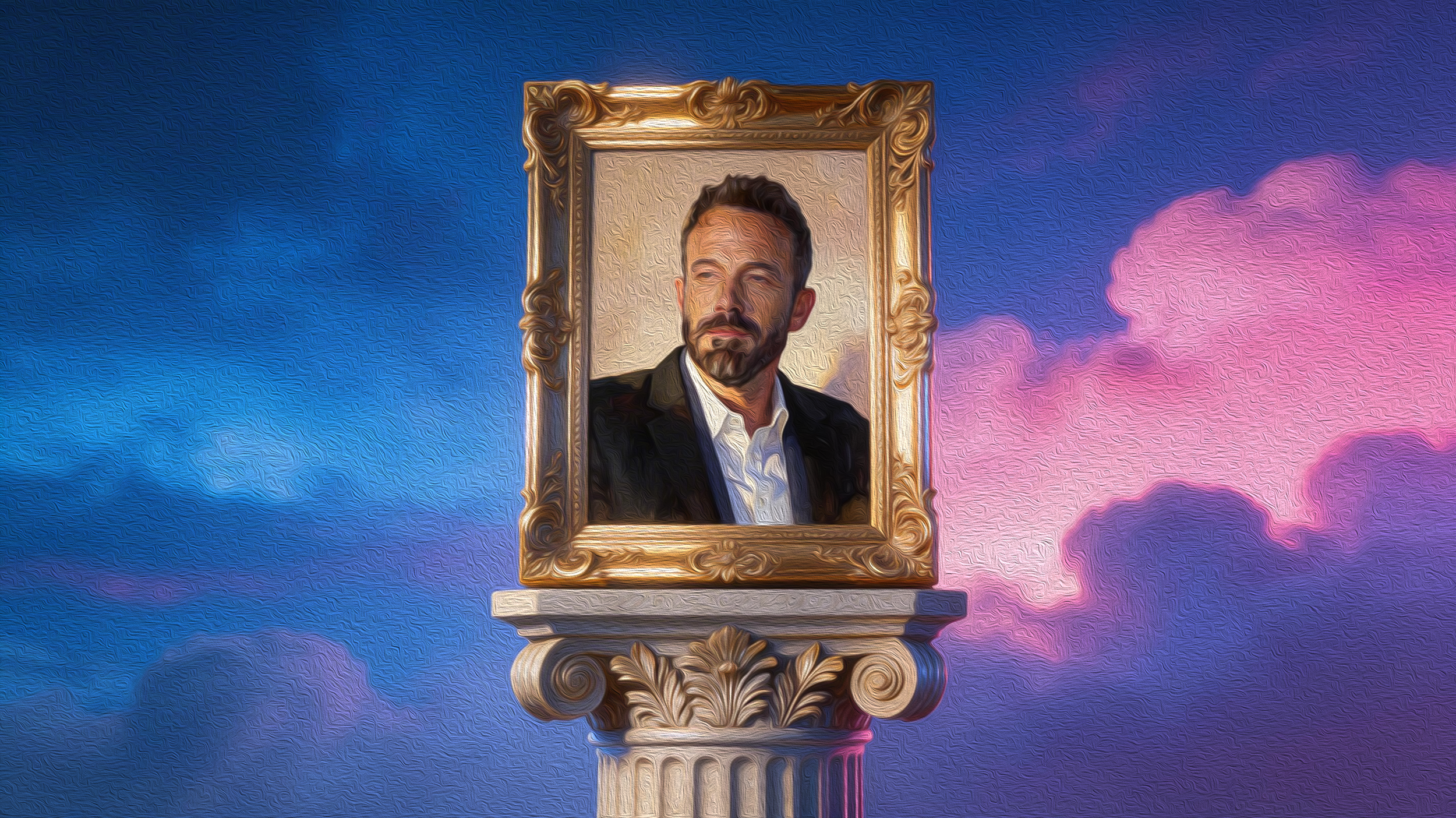
Seedream 5 lite + Photoshop: Curt Doty
I finally watched the Joe Rogan interview with Ben and Matt when they discussed AI. And when Ben went off on his take, it mirrored almost everything about AI in film that I’ve been writing about, discussing on my podcast, and evangelizing through my AI Salons.
That moment hit me like déjà vu.
For the last two years, the conversation around AI in Hollywood has mostly been framed by fear. The narrative has been predictable: AI will replace writers, actors, editors, directors—pick your guild, insert your panic. The headlines scream about digital actors and algorithmic screenplays while the picket lines chant about the machines.
But what Ben Affleck articulated in that interview—and what his recent move quietly confirms—is something very different.
Last week, Affleck sold his small AI company, InterPositive, to Netflix.
On the surface, this sounds like a modest tech acquisition. In reality, it was a team of roughly a dozen engineers moving under Netflix’s roof. No billion-dollar headline. No splashy product launch.
But culturally, it’s a much bigger signal.
Because what just happened is Hollywood beginning to sell its own technological future to itself.
This wasn’t Silicon Valley dropping a black-box AI system onto the film industry. It wasn’t a startup founder who had never stepped on a set explaining how cinema should work. This came from inside the house. From a filmmaker who understands production, editing, post, and the endless technical friction that sits between the idea in your head and the final frame on screen.
The tools InterPositive built weren’t about replacing storytellers. They were about smoothing the production pipeline: removing wires and equipment from frames, optimizing images, accelerating post-production workflows, cleaning up the tedious work that eats budgets and schedules.
In other words, AI is entering Hollywood not through creativity—but through infrastructure.
And that’s exactly how every technological revolution in filmmaking has happened.
The camera didn’t replace the director. Avid didn’t eliminate editors. Digital cameras didn’t erase cinematographers. They changed the workflow. They removed friction. They made things faster, cheaper, and sometimes better.
The Television Academy recently acknowledged this reality in its own way when it clarified that generative AI tools do not help or hurt award eligibility—as long as a human remains at the heart of creative authorship.
Translation: the machine doesn’t win the Emmy. The storyteller does.
But if AI is making filmmaking faster and more accessible, that raises a more interesting question—one that almost no one in Hollywood is talking about.
What happens when production stops being the bottleneck?
For more than a century, filmmaking has been defined by scarcity. Cameras were expensive. Film stock was expensive. Post-production was expensive. Distribution was controlled by a handful of studios that decided what audiences were allowed to see.
Capital was the gatekeeper.
Generative AI—and the broader wave of AI-assisted production tools—are breaking that model.
Today a filmmaker with a laptop can generate storyboards, concept art, rough visual effects, voice tracks, and even short cinematic sequences that previously required an entire studio pipeline. Tools like Runway, Veo, and others are already allowing creators to visualize ideas that would have been impossible without millions of dollars in production resources.
This doesn’t mean the machines are directing movies. It means the barrier to entry is collapsing.
And that’s where Affleck’s move becomes the zeitgeist moment.
Because when a Hollywood A-lister publicly leans into AI—rather than resisting it—it changes the tone of the entire industry.
Hollywood has always been a herd culture. When one big name embraces a shift, others suddenly become curious. When two or three do it, the resistance collapses.
That’s what we’re watching right now.
Not the AI revolution.
The celebrity adoption curve.
For the past year, technologists, indie filmmakers, and AI researchers have been waving the flag about this transformation. But Hollywood doesn’t move because engineers say something is possible. It moves when cultural power endorses it.
When someone like Ben Affleck steps in and says, essentially, this is useful, the conversation shifts.
Suddenly the question isn’t “Should we ban AI?”
The question becomes “How fast can we integrate it?”
But here’s the paradox no one is addressing yet.
If AI dramatically accelerates the production of stories, then content itself stops being scarce.
And when content stops being scarce, something else becomes scarce.
Audience attention.
We are already drowning in content. Streaming platforms release hundreds of shows and films each year. Social media platforms generate billions of minutes of video every single day.
Now imagine a world where the cost of producing cinematic visuals drops by 90 percent.
There will be more films.
More series.
More short-form storytelling.
More experimental narratives.
But the number of hours in a day will remain exactly the same.
A viewer simply cannot watch everything.
Which means the real battle in the AI era will not be production.
It will be engagement.
The ability to capture and sustain human interest.
This is where the next evolution of storytelling begins.
For decades Hollywood tried to manufacture engagement through technology. Bigger effects. IMAX. 3D. 4D. VR. Each innovation created a temporary spike in excitement before audiences adapted and the novelty faded.
Because spectacle alone doesn’t create lasting interest.
Psychology does.
The real protagonist of any story is not the author. Not the actor. Not even the fictional hero on screen.
It’s the viewer.
Their curiosity.
Their empathy.
Their emotional investment.
And if AI is about to make content creation exponentially easier, then the filmmakers who thrive won’t simply be the ones who know how to use the tools.
They’ll be the ones who understand how to engineer attention.
Call them interest creators. Narrative engineers. Story architects.
The tools will be democratized. The craft will not.
This is why the fear narrative around AI replacing filmmakers is so misguided. Even the technologists building these systems acknowledge that AI is augmenting workflows, not autonomously making films. The industry is entering an era of enhancement rather than full automation.
Machines will accelerate the pipeline.
Humans will still decide what matters.
And that’s why Affleck’s Netflix move matters.
Not because twelve engineers joined a streaming company.
But because a respected Hollywood storyteller just validated the idea that AI belongs inside the creative ecosystem—not outside of it.
This moment reminds me of the early days of digital filmmaking. The purists said digital cameras would destroy cinema. The skeptics argued that editing on computers would cheapen the craft.
Instead, those tools expanded the number of voices that could participate.
AI will do the same.
The studio system was built on scarcity—of capital, access, and technology. AI is dissolving those constraints. Independent creators, small teams, and global storytellers now have the ability to produce cinematic work without asking permission from the traditional gatekeepers.
That doesn’t mean the studios disappear.
But it does mean their monopoly on production is fading.
And when Hollywood celebrities themselves start embracing these tools, the dam really begins to crack.
So yes—this week’s headline was about Netflix buying a small AI company.
But culturally, it was something much bigger.
It was the moment when Hollywood stopped pretending AI was coming…
…and started quietly hiring it.
Sources:
https://www.youtube.com/watch?v=AVEZBy1uAk8
https://www.barrons.com/news/ai-offers-hope-for-young-filmmakers-dreaming-of-an-oscar-dfab0cd7
https://apple.news/AX5IV2_9pQd2BRNbojEGfbA
https://www.clowdfilmfest.com/blog/the-hollywood-that-was
https://www.clowdfilmfest.com/blog/in-the-blink-of-an-eye
https://www.clowdfilmfest.com/blog/the-ai-film-backlash-misses-the-real-revolution
https://www.clowdfilmfest.com/blog/ai-films-the-next-generation
ABOUT THE AUTHOR
Curt Doty is a former studio executive and award-winning creative director with deep leadership experience across the entertainment and branding industries. Ten years in Television. Ten Years in Movies.
As the founder of CurtDoty.co, a creative consultancy, Curt has led integrated marketing, multi-channel storytelling, branding, identity, and user experience initiatives for a diverse roster of clients.
Over the past 15 years, Curt has leaned into innovation—leading R&D projects at Apple, Toshiba, and Microsoft, and pioneering interactive content.
Today, Curt’s work also explores the intersection of AI and entertainment. A sought-after fractional leader (CCO, CMO), speaker, and AI educator, he focuses on demystifying AI for creatives and executives alike.
Curt is a sought after public speaker having been featured at Mobile Growth Association, Mobile World Congress, App Growth Summit, Promax, CES, CTIA, NAB, NATPE, MMA Global, New Mexico Angels, PRSA, EntrepeneursRx, Digital Hollywood, SHRM, Streaming Media NYC, and Davos Worldwide. Download his speaker presskit here.
Through public speaking, keynotes and podcasts, Curt is continuing his role as a visionary voice in the future of creativity. He is now a board member of The Human AI Innovation Commons, Encoding Equity Into AI-Generated Prosperity. A framework for ensuring the innovations arising from Human – AI collaborations benefit humanity broadly, not just corporate shareholders.