THE BEAT POETS SOCIETY
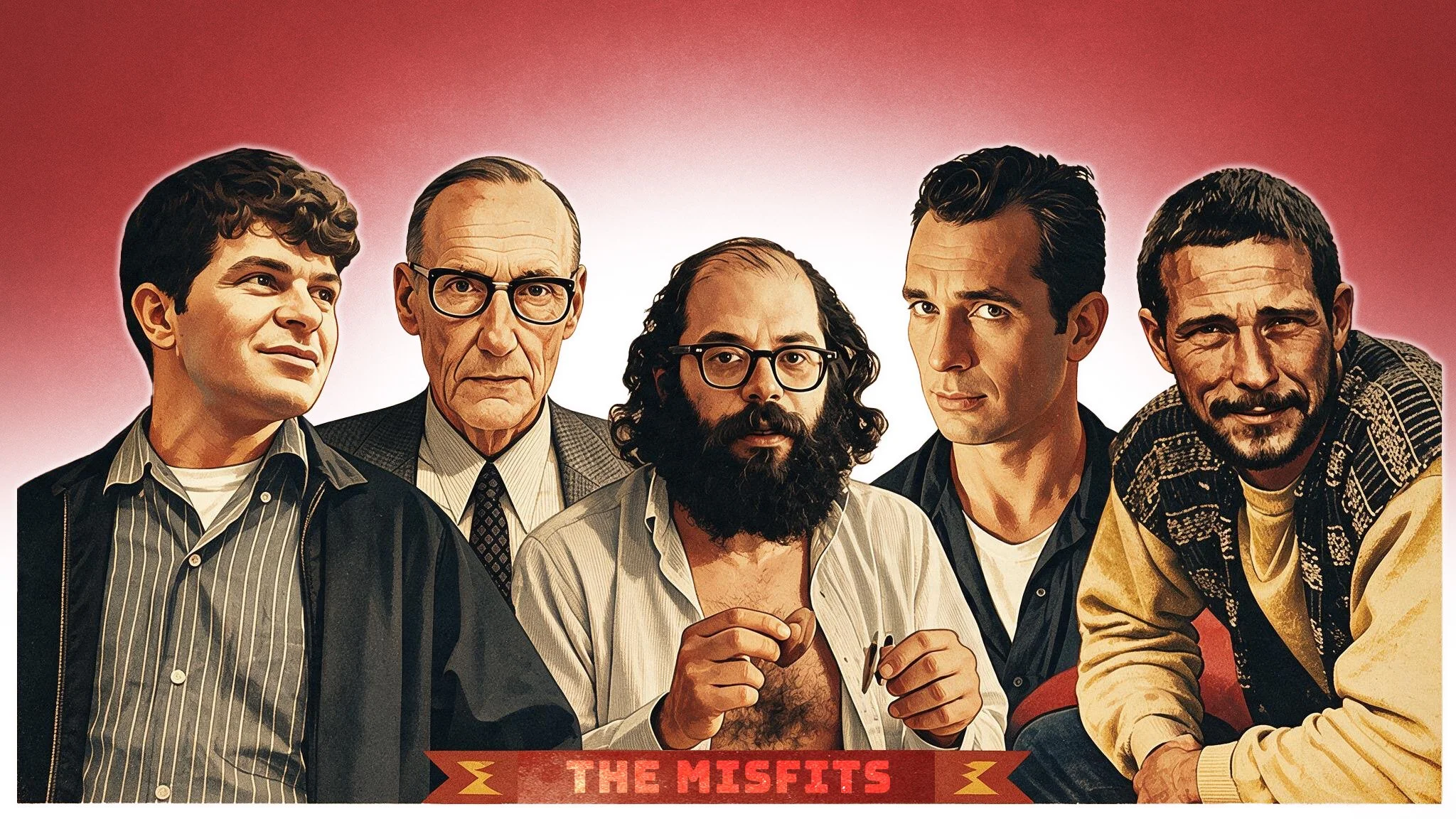
GPT 2/Seedance 5.0: Curt Doty
What the Misfits of AI Filmmaking Can Learn From the Original Creative Outlaws
Before there were prompts, there were poems. Before AI filmmakers were accused of destroying cinema, a bunch of writers in the 1950s were accused of destroying literature. They were weird. Sexual. Unpolished. Experimental. Improvisational. Political. Spiritual. High. Gay. Buddhist. Jazz-obsessed. Anti-establishment. And, according to much of respectable America, they weren't writing real poetry. Sound familiar? Welcome to The Beat Poets Society.
I keep looking at the strange little insurgency happening around AI filmmaking and thinking we've seen this movie before. Not the technology. The people. Every creative revolution seems to begin with a collection of misfits who don't quite belong in the institution they're supposedly threatening. In the 1950s they were Allen Ginsberg, Jack Kerouac, William S. Burroughs, Gregory Corso, Gary Snyder, Lawrence Ferlinghetti and the loose collection of writers eventually labeled the Beat Generation. Today they're filmmakers sitting behind laptops, stitching together Runway, Veo, Kling, Midjourney, ElevenLabs and whatever dropped last Tuesday.
Hollywood doesn't quite know what to call them. AI filmmakers? Prompt jockeys? Technologists? Hacks? Maybe we're asking the wrong question. Maybe they're just the latest outsiders who found a new way to make something.
America in the 1950s liked conformity. Get the job. Buy the house. Have the kids. Watch television. Don't ask too many questions. The Beats asked all of them. They pushed against consumerism, sexual repression, conventional religion, literary decorum and the increasingly sanitized vision of postwar American life. They were fascinated by jazz because jazz moved. They explored Buddhism because Western materialism wasn't answering their questions. They wrote about drugs, madness, homosexuality, alienation and spiritual hunger because polite literature often wouldn't.
Most importantly, they rejected the idea that art needed permission. Their work could be messy, spontaneous, personal, performed and alive. They weren't trying to make poetry behave. They were trying to make it breathe.
On October 7, 1955, a group of poets gathered at the Six Gallery in San Francisco. Not Madison Square Garden. Not a university auditorium. An art gallery. Allen Ginsberg stood up and read part of a new poem called Howl. Jack Kerouac was in the room, reportedly shouting encouragement as Ginsberg read. Something happened. Poetry stopped feeling like something preserved under glass and started feeling like an event. A performance. A happening. A scene.
That distinction matters because cultural movements rarely begin inside the institutions that eventually celebrate them. They begin in galleries, coffeehouses, bookstores, basements, tiny theaters—anywhere outsiders can afford the rent. Today? They begin on Discord, YouTube, Vimeo, LinkedIn and at film festivals nobody in Hollywood had heard of three years ago. The venue changes. The impulse doesn't. Make something. Find your people. Show it.
The establishment didn't merely dislike Howl. It tried to stop it. After Lawrence Ferlinghetti's City Lights published Howl and Other Poems, U.S. Customs seized hundreds of copies on obscenity grounds. City Lights bookstore manager Shigeyoshi Murao was arrested for selling it. Ferlinghetti was prosecuted for publishing it. Think about that for a moment. Today Howl is taught in universities. In 1957, people faced prosecution over it.
That is how quickly the definition of acceptable culture can change. What offended people wasn't simply vocabulary. Ginsberg was writing openly about homosexuality, drugs, mental illness, capitalism, conformity and a society he believed was crushing the people inside it. The obscenity trial therefore became something larger than one poem. It became a fight over who gets to define art.
And there's the connection.
Listen carefully to the criticism surrounding AI filmmaking. A lot of it isn't actually criticism of the films. It's criticism of the legitimacy of the filmmaker. You didn't shoot it. You didn't animate it. You didn't hire actors. You didn't build the set. You typed something. Therefore: That's not filmmaking.
Maybe. But history should make us a little suspicious whenever an established creative culture starts defining art primarily by the tools required to make it. Photography wasn't painting. Movies weren't theater. Recorded music wasn't live music. Digital editing wasn't cutting film. CGI wasn't practical effects. And AI filmmaking isn't traditional filmmaking. Correct. That's precisely why it's interesting.
The most exciting AI filmmakers right now aren't necessarily working on studio lots. They're outside the gates. Small teams. Independent creators. VFX artists. Animators. Directors experimenting after hours. People combining traditional production with generative tools in ways that don't fit neatly into either Silicon Valley or Hollywood. Some of the work is extraordinary. A lot of it is terrible. Good. That's what an emerging movement looks like.
The early Beats weren't a polished content vertical either. They were experimenting in public. That's what creative movements do before somebody gives them a panel at a conference and ruins everything. The danger isn't that AI filmmaking looks unfinished. The danger is trying to make it respectable too quickly.
This is where I've been beating the drum for Creative-Centered AI. The future of AI filmmaking shouldn't belong to people who merely know AI. It should belong to people who know filmmaking: directors, writers, cinematographers, production designers, editors, animators, actors, composers and storytellers. People with taste.
Because access to a new instrument does not automatically make someone an artist. Owning a saxophone didn't make you Charlie Parker. Typing "cinematic lighting" doesn't make you Roger Deakins. The tools are becoming democratized. Taste isn't. Storytelling isn't. Point of view certainly isn't.
That may ultimately be the greatest lesson the Beats have for AI filmmakers. They weren't radical because they discovered a clever new writing technique. They were radical because they had something to say.
Hollywood has traditionally operated on scarcity: a limited number of studios, a limited number of screens, a limited number of production slots and a limited number of people who can say yes. AI attacks that scarcity. A filmmaker can now visualize a world before raising millions of dollars to build it. A writer can create a proof of concept. An animator can attempt something previously requiring a studio. A tiny creative team can suddenly punch far above its economic weight.
That doesn't make Hollywood obsolete. It makes permission less important.
And that may be what really scares the establishment.
The disruptive idea isn't that AI can make movies without people. It's that people may be able to make movies without Hollywood.
The Beats didn't wait for the literary establishment to invite them in. They built their own scene. They found their own venues. Ferlinghetti gave them a bookstore and a publishing house. Audiences found them. Eventually the establishment followed.
So where is our City Lights? That's the question AI filmmakers should be asking. Not, When will Hollywood accept us? But, What are we building while it doesn't?
Where are the new Six Galleries? Where is the City Lights of AI cinema? Where are the filmmakers, writers, actors, animators and technologists gathering to argue, experiment, fail, collaborate and invent a language that doesn't exist yet? Maybe it's an AI film festival. Maybe it's a creator collective. Maybe it's a new independent studio. Maybe it hasn't been invented yet.
But movements need places. They need communities. They need critics. They need manifestos. And occasionally they need somebody willing to stand in a room full of strangers and make something so uncomfortable that everyone realizes the culture just moved six inches.
I'm not comparing the hardships of AI filmmakers to what the Beats endured. Ginsberg and his contemporaries confronted censorship, homophobia, prosecution and a society far less tolerant of difference than ours. That's real history and shouldn't be reduced to a convenient tech metaphor.
But creative establishments have a recurring habit. They confuse unfamiliarity with illegitimacy. They laugh. Then they attack. Then they appropriate. Then they hand out awards.
The Beat Generation didn't destroy literature. It expanded what literature was allowed to be. Maybe the misfits experimenting with AI won't destroy filmmaking either. Maybe they'll expand what filmmaking is allowed to be.
But there's one requirement.
They have to stop trying so desperately to prove that AI can imitate Hollywood. The Beats didn't win by writing better establishment poetry. They sounded like themselves.
That's the challenge for AI filmmakers now. Stop demonstrating the machine. Stop making pretty shots of astronauts, cyberpunk cities and women staring dramatically into the middle distance.
That is why I started CLOWD. I am not trying to be the Academy Awards, but rather build a community, a home for the Misfits. Find your voice. Create something worth saying. Find your Six Gallery.
Then stand up and Howl.
About the Author
Curt Doty is a former studio executive and award-winning creative director with deep leadership experience across the entertainment and branding industries. Ten years in Television. Ten Years in Movies.
As the founder of CurtDoty.co, a creative consultancy, Curt has led integrated marketing, multi-channel storytelling, branding, identity, and user experience initiatives for a diverse roster of clients.
Over the past 15 years, Curt has leaned into innovation—leading R&D projects at Apple, Toshiba, and Microsoft, and pioneering interactive content and vertical storytelling.
Today, Curt’s work also explores the intersection of AI and entertainment. A sought-after fractional leader (CCO, CMO), speaker, and AI educator, he focuses on demystifying AI for creatives and executives alike.
Curt has launched the CLOWD AI Film Festival. Check it out here and enter your AI Films.
Curt is a sought-after public speaker having been featured at Mobile Growth Association, Mobile World Congress, App Growth Summit, Promax, CES, CTIA, NAB, NATPE, MMA Global, New Mexico Angels, PRSA, EntrepeneursRx, Digital Hollywood, SHRM, Streaming Media NYC, and Davos Worldwide. Download his speaker press kit here.
Through public speaking, keynotes and podcasts, Curt is continuing his role as a visionary voice in the future of creativity. He is a board member of The Human AI Innovation Commons, Encoding Equity Into AI-Generated Prosperity. A framework for ensuring the innovations arising from Human – AI collaborations benefit humanity broadly, not just corporate shareholders. Curt is also a board member of the Godfrey Reggio Foundation.