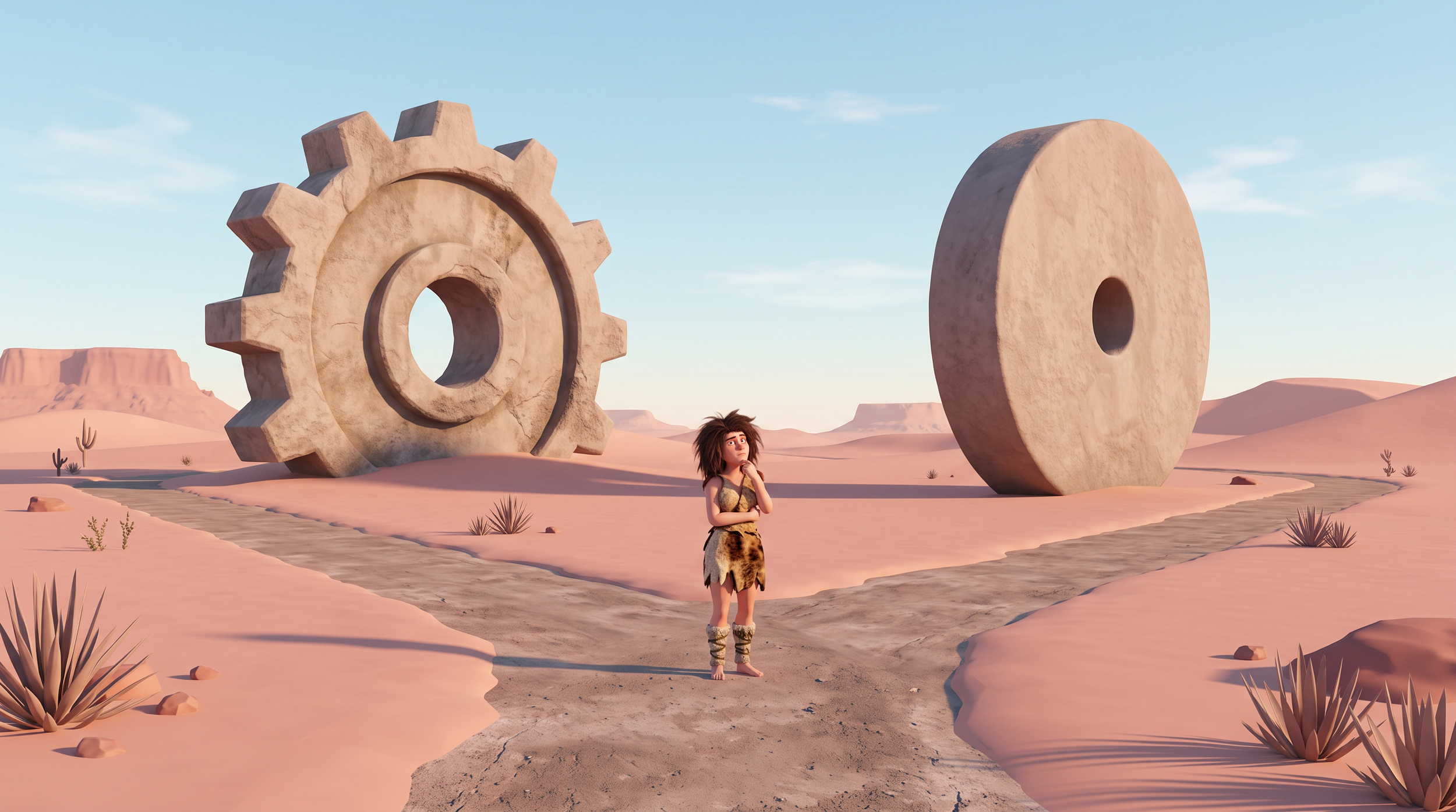
google nano banana 2.1: Curt Doty
You’ve mastered the tools. You’ve made the short. You’ve collected the laurels. Now comes the question the festival circuit cannot answer for you: How are you going to make a living?
Around the world, AI filmmakers are reaching this moment together. Some want clients. Some want representation. Some want Hollywood. Others want to build something Hollywood will eventually want.
The choice is becoming clearer: become a valuable part of someone else’s production machine, or build the wheel yourself.
Neither path guarantees success. Drifting between them without deciding what you’re building is a business risk of its own.
From Slop to Storytellers
I think of the early GenAI video timeline in periods.
First came the novelty flood: memes, visual stunts, strange creatures, and clips whose main achievement was existing. I call it the “AI Slop” period. Mainly led by hacks, there were inventive experiments, certainly, but technical novelty often stood in for creative intention.
Then came what I call the “Storyteller” period.
Professional people with taste, discipline, and something to say began mastering these tools. Many came from advertising, animation, design, and visual effects. Others had stories waiting for a practical way onto the screen.
They brought direction, character, rhythm, and emotional purpose. They separated themselves from the noise by finishing work worth watching.
AI film festivals gave this community a place to gather. Filmmakers entered competitions, won awards, gained visibility, and built credibility. Recognition traveled faster than revenue.
A beautiful collection of laurels still doesn’t pay the rent.
Advertising pays first
For many, advertising offers the quickest route to paid work. There are briefs, budgets, deadlines, and buyers who already understand commissioned production.
The adoption is substantial. IAB reported in July 2026 that nearly two-thirds of surveyed digital video buyers were using GenAI for creative work, up from half in 2025. iab.com
Related article: Canne Fusion
Clients increasingly ask what AI can deliver. Alongside that curiosity comes a familiar expectation: faster work should cost less.
That creates opportunity and pressure. Experienced commercial creatives can apply existing skills through new workflows. But filmmakers should be careful about letting the technology become their entire value proposition.
If you sell yourself primarily as cheaper production, someone will eventually offer cheaper production.
Sell judgment. Sell ideas. Sell the ability to deliver something a client cannot get by opening the same platform.
Related article: The Beat Poets Society
Hollywood or your own audience?
For aspiring auteurs, the questions get more complicated.
Will Hollywood accept AI filmmakers? What is the route in? A studio job? Representation? A finished feature? A character or world someone wants to acquire?
Do you need Hollywood at all?
That question feels especially relevant while the established business wrestles with its own economics. An independent filmmaker can keep creating, build followers, test ideas, and develop a direct relationship with an audience.
An audience can become leverage. Hollywood understands the attraction of creators who arrive with people already paying attention. But followers aren’t automatically ticket buyers, and visibility isn’t automatically a sustainable business.
The filmmaker still has to build the bridge.
The Infrastructure Arrives
Predictably, companies are forming around this uncertainty: talent directories, representation businesses, curated showcases, production collectives, guilds and studios assembling rosters.
Wonder Studios, for example, describes a global talent network spanning directors, editors, designers, cinematographers, and VFX artists. AI Artists’ Media combines representation, commissions, and production. Wonder Studios
AI Casting Services is The marketplace where AI creators, technicians, and visionaries are the talent. From first submission to final booking. The full casting workflow, built for AI creators, AI technicians, AI executives, and the productions that hire them.
The AI Filmmakers Directory helps producers, brands, and collaborators discover AI filmmakers around the world.
Shaike Studio will create your cinematic AI film with their community of the world’s best AI creatives. 500+ top Creators
from 70+ countries.
Mostra is a catalogue of AI Filmmakers where you can watch the work and also see how it was made.
RAD TV is one of the more established creator networks. Currently on 1.8 Billion devices globally. RAD enables. direct fan monetization with a real video engine: native hosting, transcoding, and adaptive HD/4K streaming to TV, consoles, and mobile devices.
These services provide valuable access. Filmmakers should ask what actually follows an introduction: paid assignments, meaningful representation, or simply another place to display a reel?
There are echoes of earlier production models. Boss Film Studios, the respected effects company, closed in 1997 amid financial pressure. Contemporary reporting described revenue consumed by the high overhead of retaining their directors and difficulty financing current work from future profits. Los Angeles Business Journal
And guilds like The AI Cinematic Films Guild (AICFG) which is a professional guild dedicated to advancing cinematic storytelling in the age of artificial intelligence. It brings together filmmakers, actors, technologists, and innovators committed to preserving the craft of filmmaking while responsibly integrating emerging AI technologies.
Its history doesn’t prove that talent rosters are unsustainable. It reminds us that assembling exceptional people and running a durable business are separate achievements.
The Cog
Joining a larger AI studio, production company, or studio division can be an excellent decision.
You gain collaborators, resources, clients, and opportunities to learn. You can specialize. You can help realize work beyond the scope of your own operation.
There is dignity and creative satisfaction in contributing to a team.
But understand the bargain. Whose stories are you developing? Who owns the resulting work? Are you building transferable expertise, or becoming dependent on one workflow?
Being a cog is a choice about where you contribute and how you earn. Make it deliberately.
The Wheel
The auteur chooses a different responsibility: develop the stories, shape the worlds, build the audience, and find a way to finance the next film.
Some filmmakers are creating studios. Some are exploring vertical microdramas. Others are building independent catalogs and communities.
This path offers control, but also work that has little to do with directing. Distribution, marketing, partnerships, and cash flow become your problems.
You may fund your original films with advertising assignments. You may collaborate extensively while retaining creative authorship. Independence doesn’t require isolation.
I heard a recent quote from a founder of an AI studio that “Platforms make clips” referring to the AI platforms, and “AI studios make Movies. What I find and support is the fact that a single AI Filmmaker can be more productive and make a better movie all by themselves.
Robert Gaudette’s A Face Only a Mother Could Love is a stellar example. It won the Judges Award at my CLOWD Film Fest and earned international recognition, including winning the 2026 Reply AI Film Festival. Reply Watch this movie here.
Related Podcast: CLOWD Masters with Robert Gaudette
For me, it demonstrates the power of a filmmaker’s voice.
The filmmakers worth following
As a festival founder and AI film judge, I have reviewed more than 1,400 AI films just this past year. The strongest work still surprises me.
It is a minority. I also see familiar names winning internationally, deservedly. That consistency suggests something beyond getting lucky with a generation.
Now we enter what I call the “AI Indie” period. Festival success has identified talent. Commercial commissions, sustainable audiences, and theatrical results will test different capabilities.
Hollywood loves winners. It loves butts in seats. But filmmakers shouldn’t confuse Hollywood’s approval with their only possible destination. AI Studios are popping up all over the world leading to the decentralization of Hollywood.
Decide what you want to own, how you want to work, and who you want to reach.
The cog or the wheel?
The choice is yours. Take the wheel if that’s your ambition—and give us a reason to come along.
About the Author
Curt Doty is a former studio executive and award-winning creative director with deep leadership experience across the entertainment and branding industries. Ten years in Television. Ten Years in Movies.
As the founder of CurtDoty.co, a creative consultancy, Curt has led integrated marketing, multi-channel storytelling, branding, identity, and user experience initiatives for a diverse roster of clients.
Over the past 15 years, Curt has leaned into innovation—leading R&D projects at Apple, Toshiba, and Microsoft, and pioneering interactive content and vertical storytelling.
Today, Curt’s work also explores the intersection of AI and entertainment. A sought-after fractional leader (CCO, CMO), speaker, and AI educator, he focuses on demystifying AI for creatives and executives alike.
Curt just completed the first CLOWD AI Film Festival. Check it out here and learn who won. He also launched CLOWD TV on the RAD TV Platform
Curt is a sought-after public speaker having been featured at Mobile Growth Association, Mobile World Congress, App Growth Summit, Promax, CES, CTIA, NAB, NATPE, MMA Global, New Mexico Angels, PRSA, EntrepeneursRx, Digital Hollywood, SHRM, Streaming Media NYC, New Mexico Tech Week, TVOT, and Davos Worldwide. Download his speaker press kit here.
Through public speaking, keynotes and podcasts, Curt is continuing his role as a visionary voice in the future of creativity. He is a board member of The Human AI Innovation Commons, Encoding Equity Into AI-Generated Prosperity. A framework for ensuring the innovations arising from Human – AI collaborations benefit humanity broadly, not just corporate shareholders. Curt is also a board member of the Godfrey Reggio Foundation.